UN Commission on the Status of Women: Rights, Justice, Action
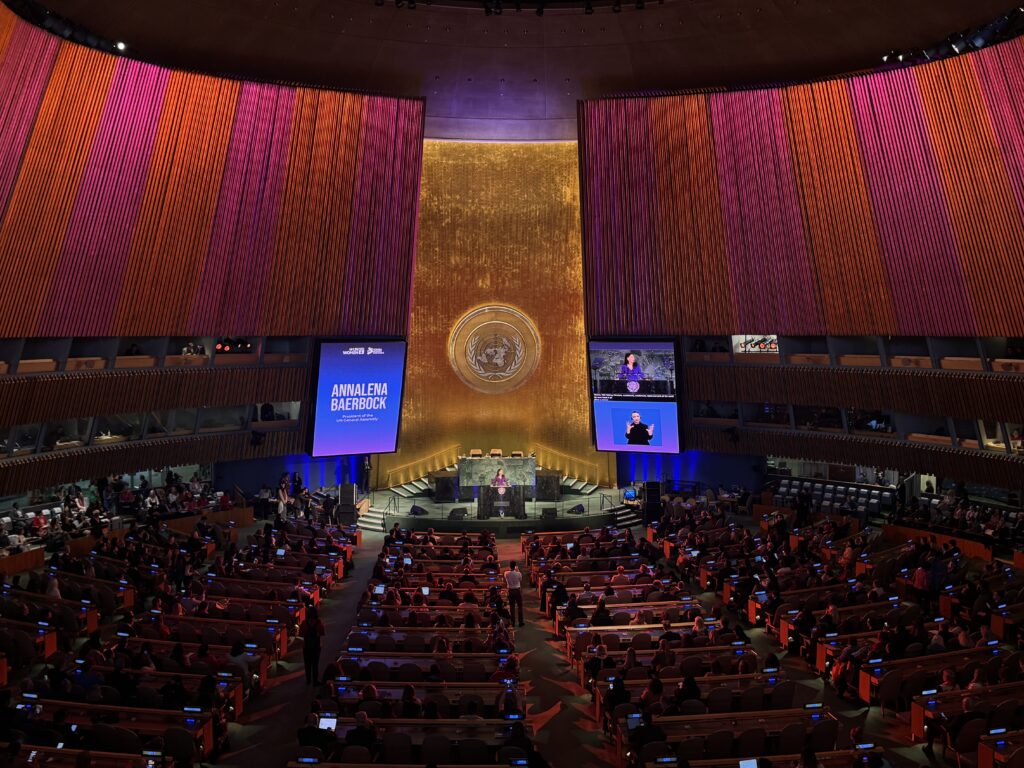
New York, United Nations Headquarters
There’s no climate justice without gender justice.
The 70th session of the United Nations Commission on the Status of Women (CSW70) convened from 8 to 19 March 2026 at UN Headquarters in New York, the world’s largest annual gathering dedicated to gender equality. With 190 member states, thousands of civil society representatives, and the eyes of global advocacy focused squarely on New York, this session carried particular weight. Its priority theme Ensuring and strengthening access to justice for all women and girls landed not as an abstract policy statement, but as an urgent reckoning with a world where no country has yet achieved full legal equality between women and men.
The session concluded with the adoption of historic Agreed Conclusions, a negotiated roadmap for building justice systems that work equally for everyone. It also unfolded against the backdrop of the upcoming appointment of a new UN Secretary-General — a decision that many believe should, at last, put a woman at the helm of the world’s most consequential multilateral institution.
International Women’s Day 2026: Rights. Justice. Action.
The session opened with the United Nations Observance of International Women’s Day on 8 March in the General Assembly Hall, held under the theme Rights. Justice. Action. For All Women and Girls. The event blended reflection, celebration, and a sharp edge of urgency — acknowledging both the progress made over decades of women’s rights activism and the very real threat of backsliding.
UN Women Goodwill Ambassador Anne Hathaway took the stage to deliver remarks that many in the room described as one of the most honest speeches the occasion had seen in years. “I’m sure I don’t have to tell you that this is a strange, thorny moment in the world. It’s very confusing to try and bridge what’s actually going on out there versus what we hope to achieve in here. It’s hard to bear the knowledge that the distance between the promise of equality and the experience of it are yet still so far apart, for so many.” Hathaway argued that celebration itself is a form of defiance — a refusal to accommodate injustice.
Nobel Peace Prize laureate Malala Yousafzai delivered a sobering address, warning that justice cannot be applied selectively. “You will be hearing a lot this week about ‘access to justice,'” she told the audience. “But true justice does not defend the humanity of children in one place and ignore it in another.” Pointing to conflicts and repression around the world, she spoke of girls in Iran, Gaza, and Afghanistan and urged governments to confront what she described as systemic discrimination against Afghan women and girls. “This is not culture. It is not religion,” she said. “It is a system of segregation and domination — we must call the regime in Afghanistan by its true name: gender apartheid.”
UN Women Executive Director Sima Bahous set the tone for the session that followed, framing the week not as ceremony, but as obligation. “Despite the many strides forward towards equality and justice, for too many women and girls, justice is selective, inaccessible, and denied. Globally, no country meets its duty of full legal equality for women and girls.” She concluded with a rallying call: “Be in no doubt: equality is within our reach.”
German Foreign Minister Annalena Baerbock, one of the session’s most prominent intergovernmental voices, put the Secretary-General selection process in direct dialogue with gender equality principles. “The choice of Secretary-General will show whether the United Nations reflects the diversity of the 8 billion people it serves,” she said, highlighting the central role civil society must play in holding member states accountable. The commemoration closed with a final call to action from Ambassador Maritza Chan Valverde, Chair of CSW70, who reminded delegates that their success would be judged not by their words in the hall, but by their willingness to exert the political will necessary to transform aspirations into reality for every woman and girl.
The Role of NGO Representatives: Why Civil Society Cannot Be an Afterthought
The active participation of non-governmental organisations (NGOs) is a critical element in the work of the Commission on the Status of Women. At CSW70, that participation was vast and essential. The NGO CSW Forum hosted over 750 events alongside the official session.
NGO representatives serve a function that member states, by their nature, cannot fully perform. They carry lived experience into rooms shaped by diplomatic language. They speak for communities whose realities rarely appear in government reports. At CSW70, youth representatives challenged the normalisation of online violence, Pacific Island delegates described how geography compounds the denial of justice for survivors, and activists from Haiti documented the labour exploitation of migrant domestic workers. They all emphasised that when women’s rights organisations are restricted or defunded, survivors lose their primary pathway to justice.
The access question itself became urgent this year. US visa restrictions meant several women’s rights activists, particularly from the global south, couldn’t enter the country, a worsening problem that limits civil society’s ability to engage. The CIVICUS 2026 State of Civil Society Report documented precisely what civil society has been facing: institutions built to protect women’s rights under sustained, coordinated attack, their funding cut and their influence deliberately constrained.
This matters beyond the confines of any single annual session. NGOs are the connective tissue between international commitments and community-level change. When they are weakened or excluded, the gap between what governments agree to in New York and what women actually experience on the ground widens. CSW70 made the case, powerfully and repeatedly, that this is a gap the world cannot afford.
No Climate Justice Without Gender Justice
The intersection of climate and gender was one of the session’s most consistent threads. Across side events, roundtables, and formal proceedings, speakers refused to treat these as separate conversations. The climate crisis and the gender equality crisis are not parallel emergencies running on different tracks. They are the same emergency, produced by the same structural failures.
Tuvalu Prime Minister Feleti Penitala Teo stated at the session: “They are the same crisis produced by the same system, a system organised around one logic: colonialism said that this land is not yours, the extractive economy said that these costs are not mine, and the patriarchy said that women’s work is not work.”
The data supports this framing. Women particularly in rural areas, small island states, and conflict-affected regions carry a disproportionate burden of climate change’s immediate impacts: food insecurity, displacement, water scarcity, increased care work following disasters. They are also systematically excluded from the policy spaces where climate responses are designed. Displacement caused by climate shocks impedes women’s access to reporting and in-person services, and domestic care burdens can prevent women from participating in legal processes. Climate stress doesn’t just harm women, it shrinks the space in which they can seek justice at all.
The session called explicitly for gender-responsive climate financing, for women’s meaningful participation in climate negotiations, and for the recognition that ecological transition without gender inclusion is not a transition worth the name.
The Energy Transition Cannot Succeed Without Women: Lessons from Kazakhstan
One of the most substantive side event conversations at CSW70 focused on the relationship between the global energy transition and gender equity using Kazakhstan as a primary case study. A high-level side event at CSW70 made the case that the energy transition cannot succeed without women.
UNDP’s work in Kazakhstan has been developing precisely this argument at a national level. UNDP Kazakhstan has been working to mainstream a gender agenda in the implementation of national climate policy, recognising that women are experiencing increased workloads, increased gender discrimination, and ultimately the feminisation of poverty as their ability to influence and participate in planning, development, and implementation of climate policies remains low.
Kazakhstan has been developing a Gender Action Plan for Climate Change aimed at achieving equal and meaningful participation of women and men in the implementation of actions on climate change, including a methodological framework on strengthening the role of women in climate action throughout the country.
Kazakhstan’s example points to a broader truth: countries standing at the crossroads of major energy transition, moving away from fossil-fuel-dependent economies, face a choice about who gets to shape what comes next. When women are included in designing clean energy policy, the outcomes are more equitable, more durable, and more trusted by the communities they are meant to serve. When they are excluded, transitions tend to replicate existing inequalities in new forms. As Kazakhstani representatives noted at CSW70, ensuring that women and girls can fully exercise their rights, including through accessible justice systems, is essential for advancing gender equality and inclusive development.
Rural Women in Africa: Land Rights, the Dandelion Project, and Environmental Outcomes
The United Nations declaration of 2026 as the International Year of the Woman Farmer brought additional focus to one of the session’s most tangible programmatic conversations: the link between women’s land rights, environmental stewardship, and community resilience in sub-Saharan Africa.
The UN has declared 2026 the International Year of the Woman Farmer, recognising rural women as critical drivers of food and nutrition security, economic prosperity, community resilience, and wellbeing. This recognition is long overdue. Across much of Africa, women perform the majority of agricultural labour while holding a fraction of the land rights. The consequences are not only economic but ecological. When women lack secure tenure, they cannot make the long-term investments in soil health, tree planting, and water management that produce lasting environmental gains.
IFAD, the Gates Foundation, BMZ, and several member states have been collaborating through the Gender Transformative Mechanisms in Climate Adaptation (GTM) to overcome barriers that limit women’s access to natural resources, strengthen women’s agency, and support communities in climate adaptation.
CSW70 also highlighted the work of the Dandelion Project, which is partnering with rural women landowners across Africa to secure legal title and extend practical support for sustainable land management. The model recognises that land rights are not merely a justice issue, they are an environmental intervention. Women with secure tenure plant more trees, protect water catchments, and make farming decisions that benefit ecosystems for generations. Communities where women have real decision-making power over land consistently outperform those where they don’t on biodiversity, soil quality, and long-term food security metrics. Strengthening the Dandelion Project’s reach, its advocates argued, is one of the most cost-effective investments in both gender equity and environmental resilience available.
The Pacific: Compounding Vulnerabilities and a Widening Justice Gap
No region faces the consequences of climate breakdown more acutely or more immediately than the Pacific. And in the Pacific, gender inequality and climate vulnerability are not simply correlated — they are structurally entangled.
The Pacific Islands Region is one of the most vulnerable to climate change across the globe. Low-lying atolls are particularly at risk of storm surge and sea-level rise, and all island nations are prone to extended droughts, warming sea temperatures, changing rainfall patterns, and increased frequency and intensity of cyclones. As climate shocks intensify, gender gaps widen. Pacific Island delegates at CSW70 described how geography compounds the denial of justice for survivors — where legal services, shelters, and reporting mechanisms may be hours away by boat, or simply absent altogether.
Kiribati and Tuvalu are among the world’s starkest examples. In Kiribati, women in coastal communities described losing not just homes but the legal ground beneath their feet — land bought out by government relocation schemes leaves women with no ownership title and no formal recourse. Participants stressed that “the land that we are planting on is being bought by the Kiribati government due to climate change, and the land we reside on is being governed by the Anglican church of which we do not have the ownership title.”
Tuvalu is the fourth smallest nation in the world and one of the most vulnerable to the impacts of climate change. With an average elevation of less than two metres above sea level, entire islands face inundation within decades. For Tuvaluan women — who are more likely to be responsible for children, elderly relatives, and household food production — displacement is not an abstract future risk but an imminent, deeply gendered reality. Access to justice in this context means access to land rights, to legal identity, to the ability to participate in relocation decisions that will determine the entire shape of their lives. At CSW70, Pacific advocates were clear: when climate finance flows into the region without gender conditions attached, it often bypasses the women doing the most to hold communities together.
Climate Finance and the Bahamas Model: Debt, Nature, and National Security
One of the most consequential climate finance conversations to emerge from the CSW70 context concerns a model that the Bahamas has helped to establish — one that reframes environmental investment not as charity, but as sovereign strategy.
The Bahamas undertook a debt-for-nature swap in a deal with The Nature Conservancy, the Inter-American Development Bank, and others, repurposing $300 million of its external debt and directing over $120 million toward marine conservation projects and climate change mitigation over the next 15 years, with an endowment fund to continue project financing beyond that period.
By repurchasing $300 million of external commercial debt using proceeds from a new $300 million loan — secured with favourable terms thanks to credit enhancements from the IDB, Builders Vision, and AXA XL — the Bahamas refinanced its scheduled debt service while simultaneously unlocking essential funding for marine and climate priorities. A notable component of the arrangement includes an option to temporarily suspend principal repayments in the event of a future pandemic or natural disaster, further enhancing the country’s financial resilience.
Prime Minister Philip Davis articulated what this means in practice: “For every dollar saved, for every reef protected, for every mangrove restored, we edge closer to the resilient Bahamas we envision. For the fishermen who rise before dawn, this project means sustainable waters teeming with life. For families living along our coasts, it means protection from storm surges and rising seas; for our children, it means a chance to inherit a Bahamas where natural beauty is preserved, and economic opportunities abound.”
The model reforestation of coastlines — through mangrove restoration and reef protection — is not merely environmental policy. It is national security. Mangroves and healthy reefs are the first line of defence against storm surge and sea-level rise; their loss has direct consequences for the safety, economic stability, and insurance costs of entire island nations. For women and girls in these communities, who often have least access to financial buffers when disaster strikes, coastal resilience is a justice issue.
The Bahamas has demonstrated that developing nations need not choose between debt sustainability and environmental investment. Researchers and policymakers are now evaluating how debt-for-nature swaps measure up with respect to financial impact, conservation impact, sovereignty concerns, and transparency — with growing consensus that the model can and should scale. The gender dimension of this scaling matters: climate finance that reaches communities through women’s leadership produces stronger environmental outcomes, lower rates of corruption, and more durable community buy-in.
The Secretary-General Selection: The World Is Watching
CSW70 concluded against the backdrop of a historic decision taking shape beyond its walls: the selection of a new United Nations Secretary-General to replace António Guterres, whose term ends on 31 December 2026.
Five candidates have been nominated: Michelle Bachelet (Chile), María Fernanda Espinosa (Ecuador), Rafael Grossi (Argentina), Rebeca Grynspan (Costa Rica), and Macky Sall (Senegal). Three of the five are women. If elected, candidates such as Michelle Bachelet or Rebeca Grynspan could become the first woman to serve as United Nations Secretary-General.
Over 190 organisations and more than 300 civil society leaders have written an open letter calling on member states to strongly consider nominating a woman. Their case is not purely symbolic. A female Secretary-General would not solve every institutional or geopolitical challenge, but electing a strong woman signals that the UN could lead by example. For decades, the organisation has urged member states to expand women’s leadership and promote gender equality. In 2026, the organisation has the chance to follow its own advice and shape the future of multilateralism.
Across 62 multilateral organisations tracked in the Women in Multilateralism Report 2026, 46 per cent of chief executives in 2025 were women — up from 42 per cent just two years prior. These changes did not happen organically. They followed deliberate policy decisions including transparency in appointments, taking civil society recommendations seriously, and mobility within multilateral organisations.
The selection process is expected to conclude in late 2026, with the Security Council making its recommendation in the second half of the year before the General Assembly formalises the appointment. The world will be watching — and so will the millions of women and girls whose daily experience of justice, safety, climate resilience, and equal rights depends, in meaningful part, on who occupies that office and what they choose to prioritise.
The evidence from CSW70 is unambiguous: when women lead — in energy policy, in land management, in climate finance, in justice systems, and in the halls of international institutions — the outcomes are better. Not marginally better. Structurally, durably better. That is the argument that 2026 has made louder than any year before it. The question now is whether the world is prepared to act on it.
Thank you to Graduate Women Otago for the Grant-in-Aid to support travel to conference and Aotearoa Women’s Watch for the accreditation to be a delegate to the session. The 71st Session of the Commission on the Status of Women (CSW71) will take place in March 2027. For more information, visit unwomen.org.